The Memory Debate: Another Cycle, or Different This Time?
Memory makers’ profits have soared over the past year. Micron earned $37.7 billion in its quarter to September 3, up from $3.2 billion a year earlier and more than in any full year before 2026. Analysts expect SK Hynix’s earnings to rise about sixfold this year and Samsung’s about sevenfold.
Yet the big memory makers trade at only 2 to 3 times the earnings analysts expect over the next year. Investors disagree about what that means. One side says memory is still a cycle and this is close to the top. The other says AI has changed how memory is bought and sold, and that a multiple this low makes the stocks cheap.
The Case for Another Cycle
Memory booms have ended the same way for decades. Memory prices follow supply and demand. When prices jump, the makers build. New plants take years, and when the supply arrives, prices fall. In Micron’s own words, supply has in past years “significantly exceeded customer demand resulting in significant declines in average selling prices.”
| Cycle | DRAM Export Price | Gross Margin, Peak to Low | Revenue | Stock | Stock Low vs. Margin Low | Cause (Micron’s 10-K) |
|---|---|---|---|---|---|---|
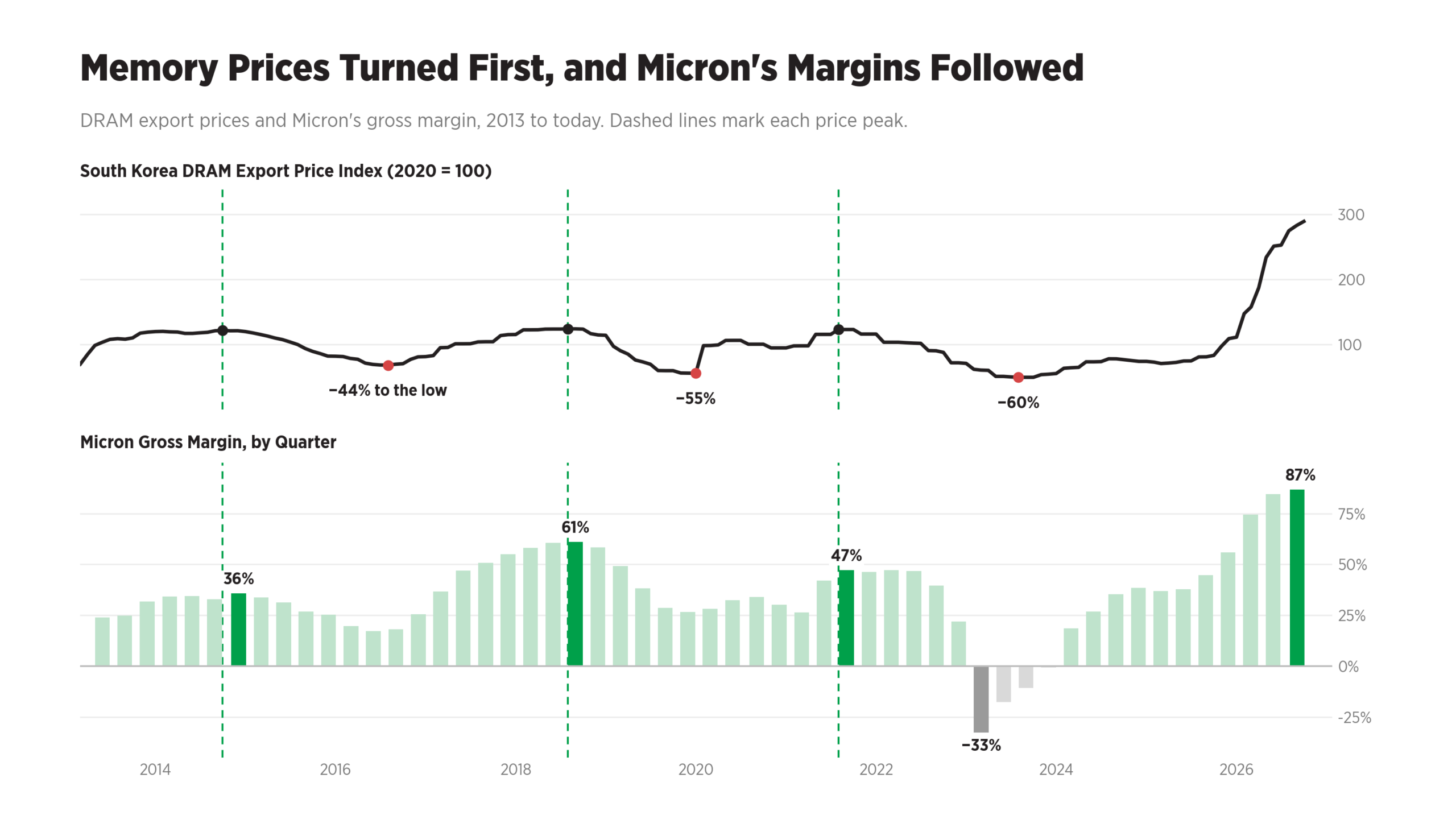
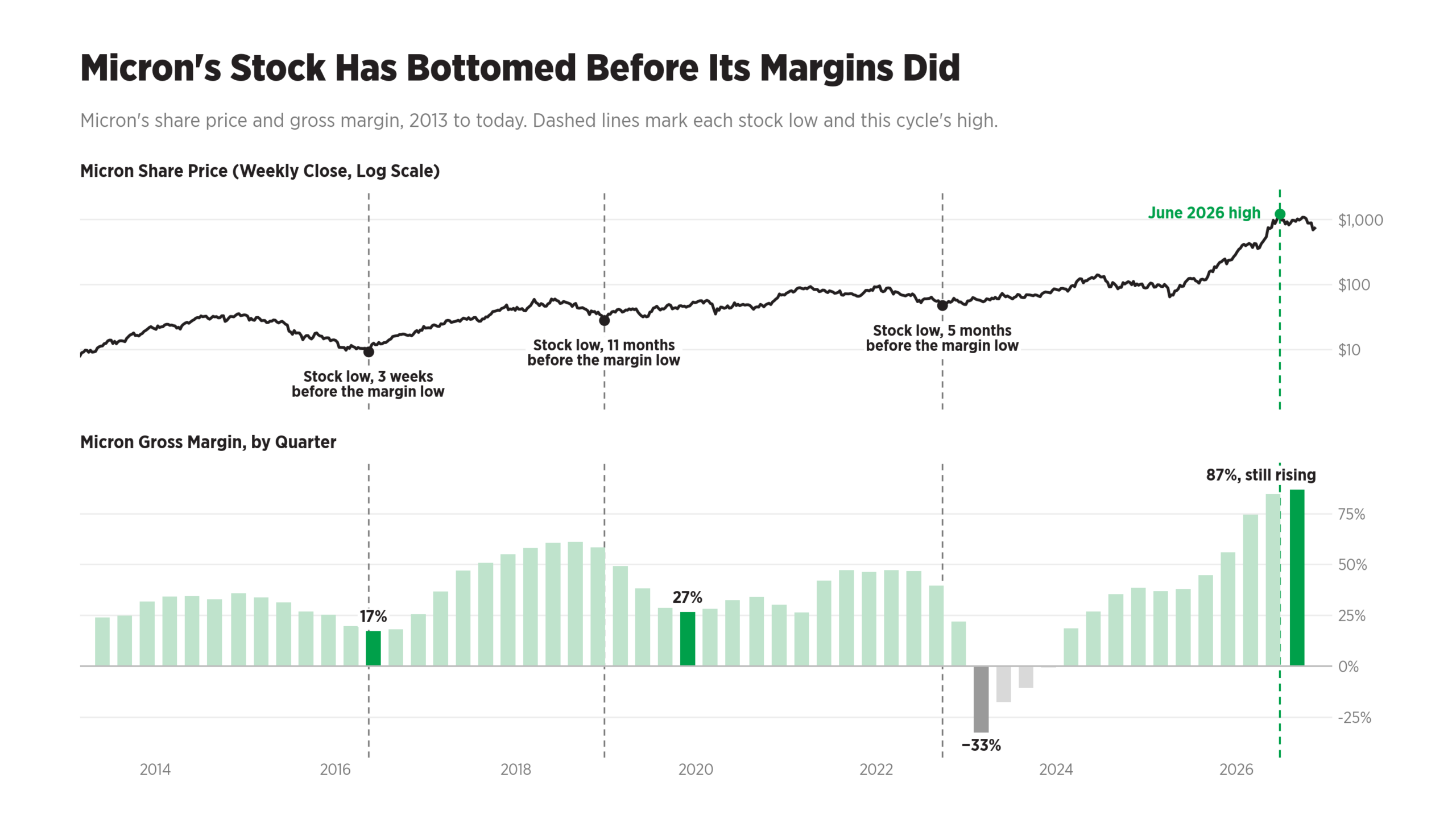
| 2014 to 2016 | -44% | 36% to 17% | -37% | -74% | 3 weeks earlier | Price declines from weakness in the PC sector |
| 2018 to 2019 | -55% | 61% to 27% | -43% | -54% | 11 months earlier | DRAM prices down about 30% on supply and demand imbalances |
| 2022 to 2023 | -60% | 47% to -33% | -57% | -50% | 5 months earlier | DRAM prices down in the high-40s percent range |
| This cycle | +248% in a year | 87% (latest) | $54.2B a quarter | -40% from June 25 high | Margins still rising | Revenue and margins still rising |
The last downturn was the deepest. In 2022 and 2023, Micron’s gross margin went from 47% to negative 33%, which means it was selling memory for less than it cost to make, and it lost money for five quarters in a row.
Memory prices drive those swings. South Korea’s DRAM export price index, a monthly Bank of Korea measure, peaked in September 2014, July 2018 and July 2021, each within a quarter before Micron’s margin peak, then fell 44%, 55% and 60%. In September it reached 289, up 248% from a year earlier and the highest since July 2010.
Micron and SK Hynix are both adding capacity. Micron spent $30.7 billion on plants and equipment in fiscal 2026, almost twice the year before, and expects to spend about $25 billion in the first half of fiscal 2027 alone. SK Hynix plans to spend at least 40 trillion won, about $30 billion, on capacity this year, up from about 30 trillion won in 2025.
Prices that rose this far have fallen hard once new supply arrived, and this time the biggest makers are expanding together. The AI demand behind the boom is also well known, and the market still pays only 2 to 3 times earnings.
The Case That It’s Different This Time
Every AI chip needs high-bandwidth memory beside it, and the biggest buyers are signing up for years of supply in advance.
Micron says more than 75% of its fiscal 2027 output is already committed, counting its Strategic Customer Agreements and other customer commitments. Customers paid it $12.7 billion in deposits in fiscal 2026. The year before, they paid none. Micron says the agreements “provide added confidence in the durability” of its results.
SK Hynix says long-term agreements already cover more than half of its production capacity for 2027 and 2028, and it expects demand to exceed supply through 2030.
If those contracts hold, much of the new supply already has a buyer, and 2 to 3 times earnings makes these stocks cheap.
Where Both Sides Meet
Micron’s latest quarter was the biggest in its history. In its quarter to September 3, revenue was $54.2 billion, against $11.3 billion a year earlier, at an 86.8% gross margin. For the current quarter it has guided to $61.5 billion, plus or minus $1.5 billion, at about 86%.
In all three past cycles, Micron’s stock peaked around the top in margins and bottomed before margins did, from three weeks to 11 months earlier. This time the stock peaked on June 25 and is now 40% below that high, while DRAM prices and Micron’s margins are still rising. So far, the stock is trading the memory cycle, even as the company reports the best results in its history.
What the Market Is Pricing
| Company | Makes | Forward P/E | Analysts’ EPS Growth, Next FY |
|---|---|---|---|
| SK Hynix | DRAM, HBM | 2.1x | +48% |
| Samsung Electronics | DRAM, HBM, Flash | 2.5x | +62% |
| Winbond | DRAM, Flash | 2.6x | +114% |
| Nanya Technology | DRAM | 2.9x | +66% |
| SanDisk | Flash | 3.0x | +27% |
| Micron | DRAM, HBM, Flash | 3.5x | +18% |
| Western Digital | Hard Drives | 7.0x | +63% |
| Seagate | Hard Drives | 7.6x | +63% |
Analysts expect every one of these companies to grow earnings again next fiscal year. The memory makers still trade at 2.1 to 3.5 times expected earnings. The multiple cannot say when a turn would come, or whether one will. It shows how much of today’s profit the market is willing to pay for.
What Would Settle It
The first sign is likely to show up in memory prices, not earnings. In each of the last three cycles, prices turned before Micron’s margins did. If contract prices hold up as the new capacity arrives, the long contracts are doing their job. A drop while the plants are still being built would look like the last three cycles.
Micron’s stock has moved first before. This time it is already 40% below its June high, while the business is still setting records.
Sources: Micron Technology quarterly and annual reports (Forms 10-Q and 10-K), fiscal 2013 to fiscal 2026, via SEC EDGAR, and Micron’s fiscal fourth-quarter 2026 results (Form 8-K, September 30, 2026). Share prices, forward P/E ratios and analysts’ estimates from Yahoo Finance, November 9, 2026. DRAM prices: Bank of Korea export price index for DRAM (2020 = 100), via Bloomberg. SK Hynix figures from its third-quarter 2026 results, as reported by Fortune and The Next Web. Company names are used for identification only and are not a recommendation to buy, sell or hold any security. Past performance does not guarantee future results.