Week Ahead: Oil, Yields And A Crowded Data Calendar
Crude is hovering around $95, Treasury yields are at multi-decade highs and the yield curve is close to inverting. This week brings PCE inflation, the September jobs report and Brazil’s first-round vote.
Markets enter the final week of the third quarter with two forces pulling in the same direction: crude oil around $95 a barrel and Treasury yields at multi-decade highs. With inflation data on Wednesday, the September jobs report on Friday and a Federal Reserve that raised rates earlier this month, this week’s calendar may determine whether the market’s expectation of an October rate increase holds.
The Macro Setup
Rates are the central story. The 10-year Treasury yield traded at 5.27% early Monday, its highest level since 2007, and the 30-year yield reached its highest since 2004. The move resumed after the United States rejected Iran’s latest proposal to reopen the Strait of Hormuz, which sent Brent crude up more than 3% before the open.1
The shape of the curve matters as much as the level. The spread between 2-year and 10-year Treasury yields narrowed to as little as 17 basis points last week, the slimmest since early 2025.2 An inverted curve has preceded each of the last eight US recessions, although that signal proved unreliable earlier this decade.2 Bloomberg Economics puts the odds of an October rate increase near 70%.3 The dollar posted its strongest run since March last week on the same hike expectations.1
The broad equity picture remains narrow. The Nasdaq-100 Index gained 3.3% last week and is up 21.8% year to date, while the S&P 500 Index gained 1.2% and is up 14.1%.4 Leadership remains concentrated in a small group of AI-linked names.
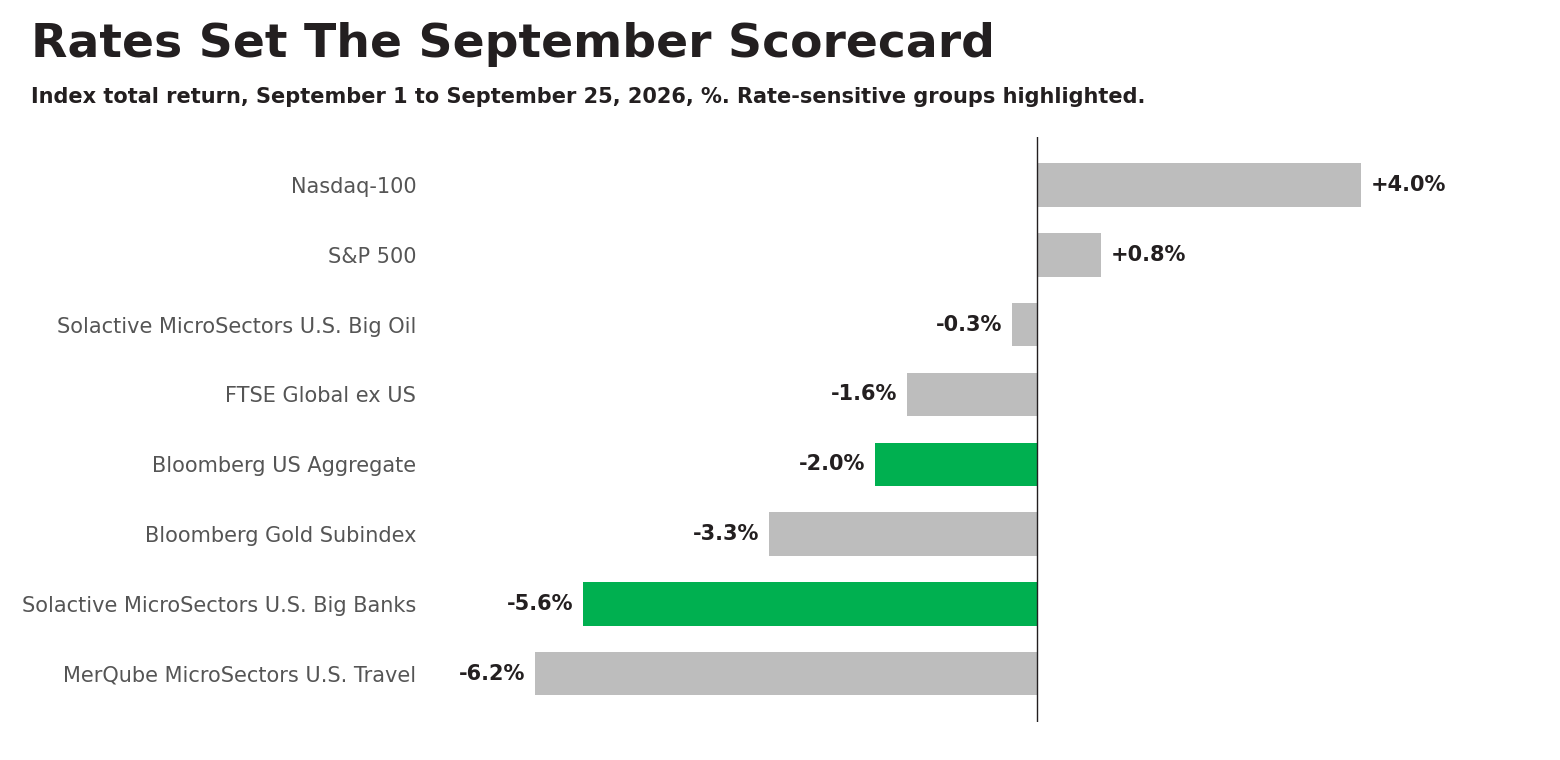
Source: Bloomberg, index total returns, September 1 to September 25, 2026. Past performance does not guarantee future results. Indexes are unmanaged and cannot be invested in directly.
The Calendar
- Tuesday. Consumer confidence and JOLTS job openings. Carnival reports earnings.
- Wednesday. August personal income, spending and PCE inflation, the Fed’s preferred inflation gauge. Micron reports earnings.
- Thursday. Initial jobless claims and the ISM Manufacturing PMI.
- Friday. September nonfarm payrolls. Bloomberg Economics expects hiring to slow to 80,000 and the unemployment rate to rise to 4.2%, which it argues could give the Fed room to hold in October.3
- Sunday. First round of Brazil’s presidential election.
Sectors To Watch
Energy. The Solactive MicroSectors™ U.S. Big Oil Index fell 4.0% last week as markets priced a possible agreement on the Strait of Hormuz, then reversed course Monday morning when talks stalled.4 The index is still up 60.1% year to date.4 Within energy, refiners have lagged producers for two weeks as the administration studies a short-term ban on US diesel exports.1 The export question and the Hormuz negotiations are the two headlines most likely to move the group this week.
Financials. Large banks have borne the brunt of rising rate expectations. The Solactive MicroSectors™ U.S. Big Banks Index closed Friday 8.6% below its August 14 high and is down 5.6% for September.4 A reported Fed plan to raise the asset thresholds that trigger stricter bank oversight is a potential offset.1 Friday’s payrolls report, which feeds directly into hike expectations, is the sector’s key event.
Technology and semiconductors. Bloomberg describes the past two weeks as whiplash for AI-exposed stocks, with sentiment swinging between fears of disruption and enthusiasm over new consumer AI products.5 Semiconductor and AI infrastructure names were weaker in Monday’s pre-market session.1 Micron’s report on Wednesday is the week’s clearest read on AI-driven memory demand and capital spending.
Credit. The Bloomberg US Aggregate Bond Index lost 0.8% last week and is down 2.3% year to date.4 Investment-grade corporate bonds, with longer duration, have been more sensitive to the move in long-end yields. Wednesday’s PCE print and Friday’s payrolls are the two data points most likely to move the long end.
Gold. Spot gold fell about 3% early Monday to near $4,155 an ounce as higher yields reduced the appeal of non-yielding metals.1 The Bloomberg Gold Subindex fell 2.3% last week and is now slightly negative for the year.4 Gold miners were lower in pre-market trading.
Travel and leisure. Travel stocks rallied Friday as oil fell: the MerQube MicroSectors™ U.S. Travel Index gained 1.8% on the day, but it is still down 6.2% for September and 13.2% below its August 7 high.4 Monday’s crude rebound works against the group. Carnival’s report on Tuesday is the sector’s main company catalyst.
International. Brazil’s presidential race remains within a few points in runoff polling: the latest BTG Pactual/Nexus survey shows 46% to 44%.1 Options traders bought downside protection on Brazilian equities ahead of the vote.6 In Japan, officials again warned against yen weakness, lifting the currency to its strongest level since September 18.1
Positioning
Equity volatility remains subdued relative to the moves in rates and oil. The Cboe Volatility Index dipped below 15 at midday Friday.6 Bank of America strategists compared current real yields to the first half of 2022 and suggested index put protection if the S&P 500 falls below 7,500.6 In rates, traders bought far out-of-the-money call spreads on long-dated Treasury exposure, positions that would benefit from a sharp bond rally.6 The contrast between calm equity volatility and active hedging in rates and emerging markets is worth monitoring as the data arrives.
The Bottom Line
This week tests a single question from several directions: whether inflation and labor data confirm the market’s expectation of another Fed rate increase. Oil sets the inflation backdrop, the yield curve reflects the growth concern, and bank, energy and credit markets sit closest to the outcome.
Sources
- Bloomberg, September 25 and September 28, 2026.
- Bloomberg, “An Inversion of the US Yield Curve Becomes New Risk as Fed Hikes,” September 28, 2026.
- Bloomberg Economics, “US Week Ahead: Unemployment Uptick to Challenge Fed Hawkishness,” September 28, 2026.
- Index total returns via Bloomberg, as of September 25, 2026.
- Bloomberg Markets Daily, September 28, 2026.
- Bloomberg First Word, US Options Snapshot, September 25, 2026.
Risks And Disclosures
Informational only. This material is for informational and educational purposes only and should not be considered investment advice or a recommendation to buy or sell any security. Forward-looking statements, estimates and scheduled events are subject to change. Past performance does not guarantee future results.
Indexes. Index performance is shown for illustrative purposes only. Indexes are unmanaged, do not reflect fees or expenses and cannot be invested in directly. Index names are the property of their respective owners and are used for identification purposes only. The Solactive MicroSectors™ U.S. Big Oil Index, the Solactive MicroSectors™ U.S. Big Banks Index and the MerQube MicroSectors™ U.S. Travel Index are licensed by REX, and their performance does not represent the performance of any exchange traded note linked to them.
Third parties. Company names and marks referenced herein are the property of their respective owners and are used for identification purposes only. Their inclusion does not imply any sponsorship, endorsement, affiliation or recommendation. Third-party research and commentary is cited for informational purposes and does not represent the views of REX or Bank of Montreal.
No political endorsement or forecast. References to elections and polling are provided as factual background on scheduled market events, are drawn from the third-party sources cited above as of the dates shown, and are subject to change. Nothing herein constitutes an endorsement of, or a prediction regarding, any candidate, party, policy or election result.
Trademarks. MicroSectors™ and REX™ are registered trademarks of REX Shares, LLC (“REX”).
Suitability. This information is not intended to provide and should not be relied upon as providing accounting, legal, regulatory or tax advice. Investors should consult with their own financial advisors as to these matters.