What Moves A Bond: A Case Study From AI Debt, The Fed And The Treasury
AI borrowing, a bigger Treasury buyback, the first Fed hike since 2023 and an oil spike all moved the bond market in August and September 2026. MicroSectors offers 3X long and -3X short ETNs on both investment grade and high yield corporate bonds.
Data as of September 25, 2026.
Two levers move a bond’s price: the rate the government pays, and the spread a borrower pays on top of it. Between August and late September 2026, four events pulled on them: AI borrowing, a bigger Treasury buyback, the Fed’s first rate hike since 2023 and, in the last full week of September, oil. Each is a working example of what moves a bond.
AI Borrowing Tested Credit
Big tech used to pay for its spending out of cash flow. On AI, Vanguard says, “That era is ending.”1 Hyperscalers issued $93 billion of debt in 2025, more than two and a half times their average from 2020 through 2024.1 When Amazon sold $25 billion of new bonds, its existing 30-year bonds widened about 20 basis points.2
The strain showed up in credit ratings and coupons. In July, S&P cut Oracle to BBB-, one notch above junk, as its AI data center spending outran its cash flow.3 CoreWeave, the AI cloud provider, priced $1.75 billion of notes at 9.75% in April and $1.25 billion at 9.625% in June.4 From August 28 to September 24, the high yield spread widened from 2.60% to 2.80%.5
The Treasury Moved The Long End
On August 19 the Treasury said it would at least double its long-end bond buybacks.6 The 30-year yield fell nine basis points that day and LQD rose 0.69%.7,8 Two sessions later the move was gone. The larger buybacks began in September, and the 30-year kept climbing, closing at 5.47% on September 24, then its highest since June 2004.7
The Fed Moved The Short End
On September 16 the Fed raised rates a quarter point to 3.75% to 4.00%, its first hike since July 2023.9 The 2-year yield rose 54 basis points in the three weeks before the decision. The 30-year rose 16.7
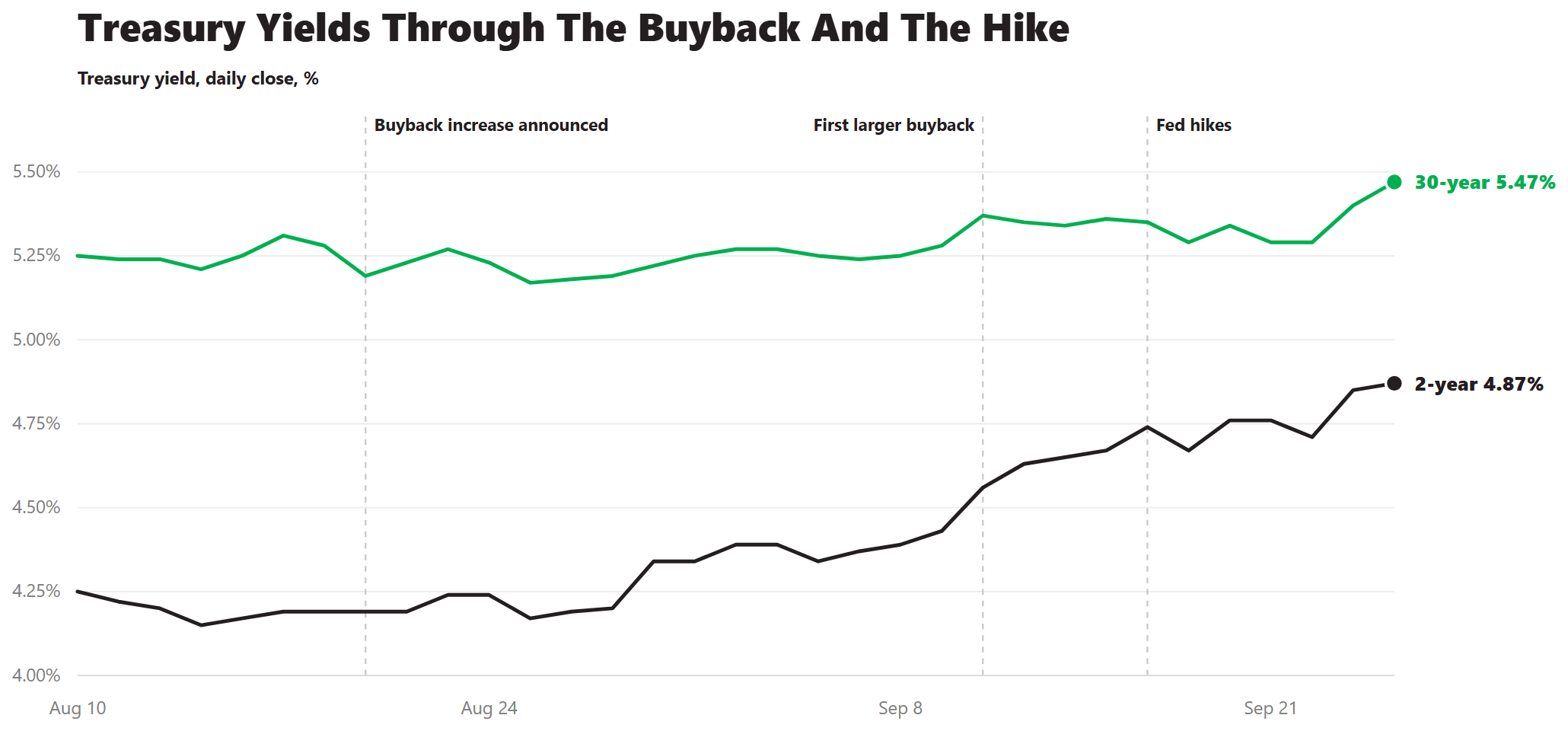
Source: U.S. Treasury constant-maturity yields (Federal Reserve H.15) via FRED, daily closes, August 10 to September 24, 2026. Event dates from the U.S. Treasury and the Federal Reserve.
Oil Moved Both Ends In Late September
LQD’s largest daily decline since August 10 came on September 23, a 1.14% drop, followed by another 0.71% on September 24, as Brent rose more than 7% over two sessions and the 10-year Treasury yield rose more than 20 basis points.11,12 On September 28, after the US rejected Iran’s proposal to reopen the Strait of Hormuz, the 10-year yield reached 5.23% in early trading, its highest since 2007, and the 30-year reached its highest since 2004. The gap between 2-year and 10-year yields narrowed to 17 basis points that week, the slimmest since early 2025.11
Small Daily Moves, Leveraged Exposure
Through all four events, corporate bonds still moved in small increments. Across the 34 sessions from August 10 to September 25, LQD’s largest daily move was 1.14%, and HYG moved half a percent or more only once.12 A half-percent day in LQD is a big one. From January 2 to September 25, its median daily move was about a quarter of one percent, and 32 of 184 sessions moved it half a percent or more.12 The pace picked up late in the period: 8 of those last 34 sessions cleared half a percent, and LQD’s 20-day volatility was in the 92nd percentile of its past year.12 At one-times exposure, those moves are modest; the ETNs apply three times the daily move, in either direction.
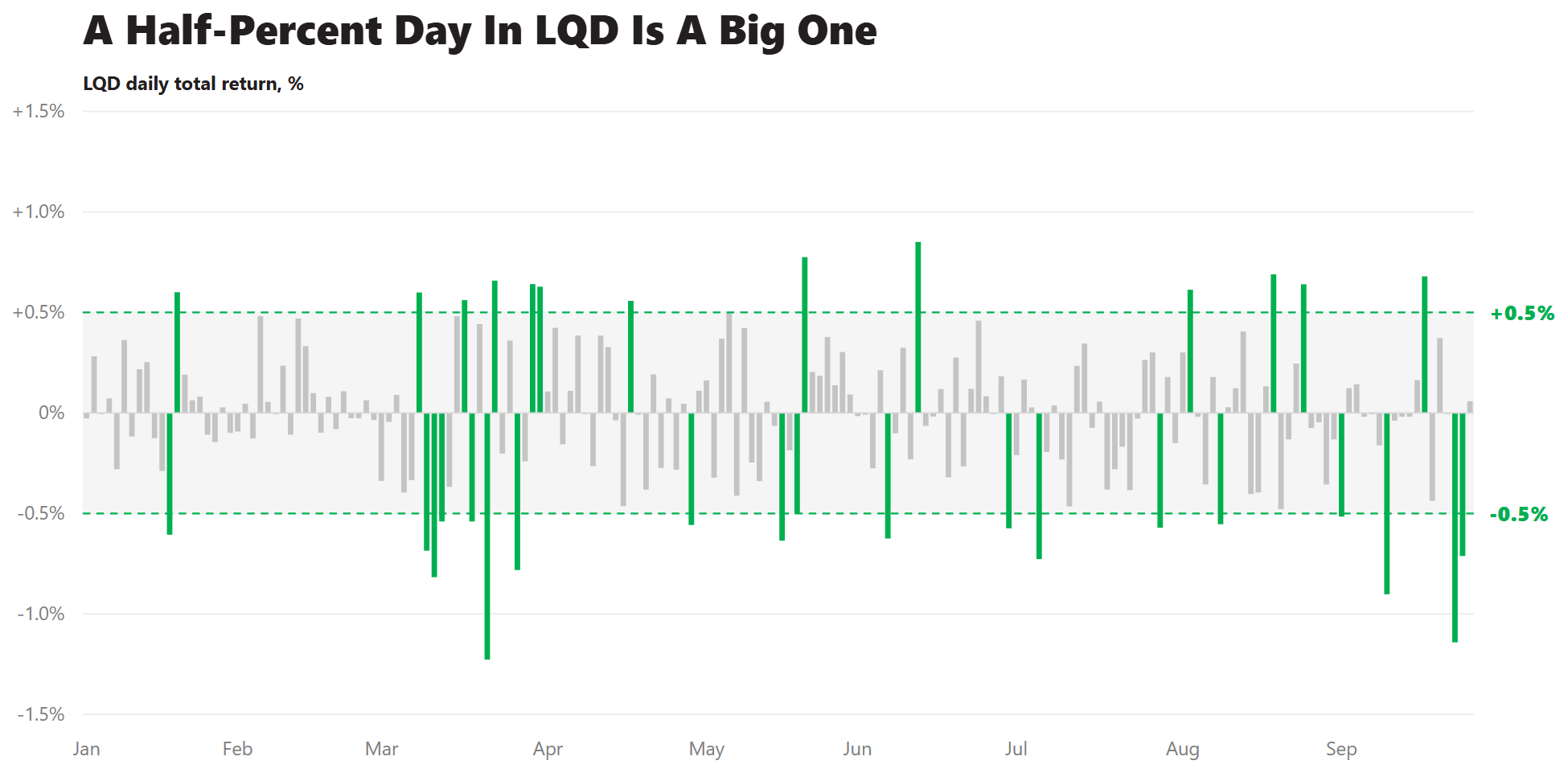
Source: Yahoo Finance, LQD daily total return (closing prices adjusted for distributions), January 2 to September 25, 2026. Past performance does not guarantee future results. LQD is not affiliated with the ETNs and is shown as the reference exposure only.
MicroSectors offers 3X long and -3X short ETNs on both investment grade and high yield corporate bonds. Each seeks three times the daily performance of its index, or three times the inverse, before fees and charges.
- Investment grade. MicroSectors™ 3× Long Investment Grade Corporate Bond (LQD) ETNs (LQDU) and MicroSectors™ -3× Short Investment Grade Corporate Bond (LQD) ETNs (LQDD). Both reference the VettaFi Investment Grade Corporate Bond Fund-Tracking Index, a total return index whose sole constituent is LQD.10
- High yield. MicroSectors™ 3× Long High Yield Corporate Bond (HYG) ETNs (HYGU) and MicroSectors™ -3× Short High Yield Corporate Bond (HYG) ETNs (HYGD). Both reference the VettaFi High Yield Corporate Bond Fund-Tracking Index, a total return index whose sole constituent is HYG.10
Learn more about LQDU and LQDD at microsectors.com/corpbonds, and HYGU and HYGD at microsectors.com/highyield.
Leverage multiplies a move against you exactly as hard as it multiplies one in your favor, and losses can reach the entire amount invested in a short period. These are daily trading tools for sophisticated investors and are not intended to be held for more than one day. Any decision to hold past the close should be made fresh the next day.
Sources
1 Vanguard, “The AI buildout comes to the bond market,” August 19, 2026.
2 Sage Advisory, “Hyperscaler Debt Deluge: The New Driver of IG Spread Pressure,” July 16, 2026.
3 S&P Global Ratings downgrade of Oracle to BBB- from BBB, July 9, 2026, as reported by The Next Web, “Oracle is one notch above junk after S&P downgrade as AI data-centre spending burns through cash,” July 16, 2026, and TheStreet via Yahoo Finance, August 14, 2026.
4 CoreWeave, Inc. press releases, April 9, 2026 and June 11, 2026.
5 ICE BofA US High Yield Index Option-Adjusted Spread, daily, August 28 to September 24, 2026, via FRED.
6 U.S. Department of the Treasury, press release sb0607, August 19, 2026.
7 U.S. Treasury constant-maturity yields (Federal Reserve H.15), daily closes, via FRED.
8 LQD and HYG daily total return (closing prices adjusted for distributions), Yahoo Finance, January 2 through September 25, 2026.
9 Federal Reserve, FOMC statement, September 16, 2026. Prior increase: federal funds target range history, via FRED.
10 Bank of Montreal pricing supplements for the ETNs, dated August 10, 2026.
11 Bloomberg News, “Oil Declines as US and Iran Explore Agreement to Reopen Hormuz” and “Bond Selloff Fades as Oil Cools, Lifting Stocks,” September 25, 2026; “US Treasury Selloff Resumes as Trump Spurns Iran Offer” and “An Inversion of the US Yield Curve Becomes New Risk as Fed Hikes,” September 28, 2026.
12 REX analysis of VettaFi Investment Grade and High Yield Corporate Bond Fund-Tracking Index daily total-return levels, January 2 through September 25, 2026.
Risks And Disclosures
Fixed-income risk. Fixed-income and corporate bond investments carry interest-rate risk (prices generally fall when interest rates rise, an effect that is greater for longer-duration indexes such as the investment-grade index) and credit risk (the risk that an issuer fails to make timely payments or is downgraded, which is more pronounced for high-yield, sub-investment-grade bonds). These risks are amplified in a leveraged or inverse product. Bonds are not “safe” or risk-free, and income is not guaranteed.
Not buy-and-hold. The ETNs are not intended to be “buy and hold” investments and are not intended to be held to maturity. Instead, the ETNs are intended to be daily trading tools for sophisticated investors to manage daily trading risks as part of an overall diversified portfolio. The ETNs are designed to reflect a 3× leveraged long or short, as applicable, exposure to the performance of the applicable Index on a daily basis, before taking into account the negative effect of the fees and charges. However, as a result of the daily resetting leverage, the returns on the ETNs over different periods of time can, and most likely will, differ significantly from three times the return on a direct long or short investment in the applicable Index. The ETNs are designed to achieve their stated investment objectives on a daily basis. The performance of the ETNs over different periods of time can differ significantly from their stated daily objectives. The ETNs are considerably riskier than securities that have intermediate or long-term investment objectives and are not suitable for investors who plan to hold them for a period of more than one day or who have a “buy and hold” strategy. Investors should actively and continuously monitor their investments in the ETNs on an intraday basis, and any decision to hold the ETNs for more than one day should be made with great care and only as the result of a series of daily (or more frequent) investment decisions to remain invested in the ETNs for the next one-day period. The ETNs are very sensitive to changes in the level of the applicable Index, and returns on the ETNs may be negatively affected in complex ways by the volatility of the applicable Index on a daily or intraday basis. It is possible that investors will suffer significant losses in the ETNs that provide leveraged long exposure even if the long-term performance of the applicable Index is positive. Similarly, it is possible that investors will suffer significant losses in the ETNs that provide short leveraged exposure even if the long-term performance of the applicable Index is negative. Accordingly, the ETNs should be purchased only by sophisticated investors who understand and can bear the potential risks and consequences of the ETNs that are designed to provide leveraged exposure to the long or short, as applicable, performance of the applicable Index on a daily basis and that will be highly volatile and may experience significant losses, up to the entire amount invested, in a short period of time.
Where to read more. For additional information, including a discussion of the risks relating to an investment in the ETNs, please carefully read the applicable pricing supplement and related documents that we have filed with respect to the ETNs (each, an “ETN Prospectus”). Investors should review the relevant ETN Prospectus carefully prior to making an investment decision. The ETN Prospectus relating to each series of ETNs can be found on EDGAR, the Securities and Exchange Commission (the “SEC”) website at: www.sec.gov, as well as on the product websites at the following links: www.bmoetns.com and www.microsectors.com.
Bank of Montreal, the issuer of each series of ETNs, has filed a registration statement (including a pricing supplement, prospectus supplement and prospectus) with the SEC regarding each series of the ETNs. Please read those documents and the other documents relating to these offerings that Bank of Montreal has filed with the SEC for more complete information about Bank of Montreal and these offerings. These documents may be obtained without cost by visiting EDGAR on the SEC website at www.sec.gov. Alternatively, Bank of Montreal, and any agent or dealer that participated in the offering of the ETNs, will arrange to send the applicable pricing supplement, the prospectus supplement and the prospectus if so requested by calling toll-free at 1-877-369-5412.
Credit risk. The ETNs are senior, unsecured obligations of BMO, and are subject to BMO’s credit risk.
Index and Reference Funds. The VettaFi Investment Grade Corporate Bond Fund-Tracking Index and the VettaFi High Yield Corporate Bond Fund-Tracking Index are service marks of VettaFi LLC (“VettaFi”). The ETNs are not sponsored, endorsed, sold or promoted by VettaFi, or its third-party licensors. The ETNs are not sponsored, endorsed, sold or promoted by the iShares® iBoxx $ Investment Grade Corporate Bond ETF or the iShares® iBoxx $ High Yield Corporate Bond ETF (each, a “Reference Fund”), BlackRock Fund Advisers (the “Reference Fund Sponsor”) or iShares® Trust. iShares® and iBoxx are trademarks of their respective owners.
Third parties. Company names and marks referenced herein are the property of their respective owners and are used for identification purposes only. Their inclusion does not imply any sponsorship, endorsement, affiliation or recommendation. Third-party research and commentary is cited for informational purposes and does not represent the views of REX or Bank of Montreal.
Trademarks and offering. MicroSectors™ and REX™ are registered trademarks of REX Shares, LLC (“REX”). The trademarks have been licensed for use for certain purposes by Bank of Montreal. The ETNs are not sponsored or sold by REX or any of its affiliates or third-party licensors. BMO Capital Markets Corp., an affiliate of the issuer, acts as the underwriter for the offerings of the ETNs. The ETNs are not insured by the FDIC, and may lose value.
Suitability. Investment suitability must be determined individually for each investor, and the ETNs are not suitable for all investors. This information is not intended to provide and should not be relied upon as providing accounting, legal, regulatory or tax advice. Investors should consult with their own financial advisors as to these matters.